|
| |
Home > Mother and Child Nutrition
|
Mother and Child Nutrition
 |
Mother, Infant and Young Child Nutrition & Malnutrition The fight against persistent underweight, stunting and wasting among children in developing countries is based on appropriate
maternal, infant and young child feeding practices including micronutrient deficiencies prevention and control. However, wasted
children are those at immediate risk of dying and will need timely detection and correct management for their survival. More than half of all child deaths are associated with malnutrition, which weakens the body's resistance to illness. Poor diet,
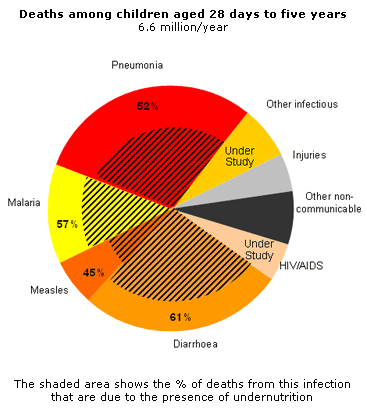
frequent illness, and inadequate or inattentive care of young children can lead to malnutrition. Of the 6.6 million deaths among children aged 28 days to five years:
1.7 million (26%) are caused by diarrhoea. 1 million (61%) of these deaths are due to the presence of undernutrition. What is needed: Enough food and the right kinds of food, Nutritional needs of girls and women, Nutritional needs of young children,
Protecting children from infections, Quality care when children fall ill, prevention of Micronutrient deficiencies. |
|
Nutrition is a fundamental pillar of human life, health and development across the entire life span. From the earliest stages of
fetal development, at birth, and through infancy, childhood, adolescence and on into adulthood, proper food and good nutrition are essential for
survival, physical growth, mental development, performance, productivity, health and well-being. More than half of all child deaths are associated with malnutrition, which weakens the body's resistance to illness. Poor diet, frequent illness, and inadequate or inattentive care of young children can lead to malnutrition. If a woman is malnourished during pregnancy, or if her child is malnourished during the first two years of life, the child's physical and mental growth and development may be slowed. This cannot be made up when the child is older – it will affect the child for the rest of his or her life. Children have the right to a caring, protective environment and to nutritious food and basic health care to protect them from illness and promote growth and development.
|
The Case for Preventing Malnutrition Through Improved Infant Feeding and Management of Childhood Illness 4 pages 219 kb 4 pages 219 kb
The advent of ready-to-use therapeutic food (RUTF) products has greatly improved the coverage and effectiveness treatment for severe acute
malnutrition (SAM). The excitement surrounding this development has led to rapid expansion of SAM treatment activities, often without regard to the
prevalence of SAM, the capacity of local health systems to absorb expansion, or the contribution of SAM to overall child mortality. In the context of
limited health budgets, on epidemiological and ethical grounds treatment approaches are in most situations a less rational public health investment
than approaches that prevent SAM and other types of malnutrition.
|
Diarrhoea is an important cause of undernutrition. This is because nutrient requirements are increased during diarrhoea, as during
other infectious diseases, whereas nutrient intake and absorption are usually decreased. Each episode of diarrhoea can cause weight loss and
growth faltering. Moreover, if diarrhoea occurs frequently, there may be too little time to "catch up" on growth between episodes, the result being a
flattening of the normal growth curve. Children who experience frequent episodes of acute diarrhoea, or have persistent diarrhoea, are more likely
to become undernourished than children who experience fewer or shorter episodes of diarrhoea. In general, the impact of diarrhoea on nutritional
status is proportional to the number of days a child spends with diarrhoea each year. In turn, undernutrition contributes to the problem of diarrhoea. In children who are undernourished as a result of inadequate feeding, previous
diarrhoeal episodes, or both, acute diarrhoeal episodes are more severe, longer lasting, and probably more frequent; persistent diarrhoea is also
more frequent and dysentery is more severe. The risk of dying from an episode of persistent diarrhoea or dysentery is considerably increased when
a child is already undernourished. In general, these effects are proportional to the degree of undernutrition, being greatest when undernutrition is severe. Thus, diarrhoea and undernutrition combine to form a vicious circle which, if it is not broken, can eventually result in death; the final event may be
a particularly severe or prolonged episode of diarrhoea or, when severe undernutrition is present, another serious infection such as pneumonia.
Deaths from diarrhoea are, in fact, usually associated with undernutrition. In hospitals where good management of dehydration is practised, virtually
all mortality from diarrhoea is in undernourished children. Diarrhoea is, in reality, as much a nutritional disease as one of fluid and electrolyte imbalance, and therapy is not adequate unless both
aspects of the disease are treated. However, in contrast to fluid replacement, nutritional management of diarrhoea requires good feeding
practices both during the illness and between episodes of diarrhoea, when the child is not sick. When this is done, and undernutrition is either
prevented or corrected, the risk of death from a future episode of diarrhoea is greatly reduced.
Infant and Young Child Feeding and Nutrition
Feeding is a critical aspect of caring for infants and young children. Appropriate feeding practices stimulate
bonding with the caregiver and psycho-social development. They lead to improved nutrition and physical growth, reduced susceptibility to common
childhood infections and better resistance to cope with them. Improved health outcomes in young children have long-lasting health effects
throughout the life-span, including increased performance and productivity, and reduced risk of certain non-communicable diseases.
Child Feeding and Nutrition ( 2-5 years age ) Malnutrition contributes to more than half of all childhood deaths, although it is rarely listed as the direct cause. For most children, lack of access
to food is not the only cause of malnutrition. Poor feeding practices and infection, or a combination of the two, are both major factors of
malnutrition. Infection – particularly frequent or persistent diarrhoea, pneumonia, measles and malaria – undermines nutritional status. Poor feeding
practices, such as inadequate breastfeeding, offering the wrong foods, giving insufficient quantities, and not ensuring that the child gets enough
food, contribute to malnutrition. Malnourished children are, in turn, more vulnerable to disease and the vicious circle is established. Improved feeding practices to prevent or treat malnutrition could save 800,000 lives per year.
- Counselling for mothers and caretakers
- Micronutrient supplements
- Management of severe malnutrition
Adolescent Nutrition
Adolescence represents a window of opportunity to prepare for a healthy adult life. During adolescence, nutritional problems originating earlier in
life can potentially be corrected, in addition to addressing current ones. It is also a timely period to shape and consolidate healthy eating and
lifestyle behaviours, thereby preventing or postponing the onset of nutrition-related chronic diseases in adulthood. As adolescents have a low prevalence of infections such as pneumonia and gastroenteritis compared with younger children, and of chronic disease
compared with ageing people, they have generally been given little health and nutrition attention, except for reproductive health concerns. However,
there are nutritional issues, which are adolescent-specific, and which call for specific strategies and approaches. The main issues in adolescent nutrition are:
- Micronutrient deficiencies (iron deficiency and anaemia)
- Malnutrition and stunting
- Obesity and other nutrition-related chronic diseases
- Adolescents eating patterns and lifestyles
- Nutrition in relation to early pregnancy
Infant and young child feeding
Breast milk is the ideal food for infants and is all they need for optimal growth and health during the first six months of life.
Breastfeeding is considered a pillar of child survival; it provides nourishment, helps develop the immune system, improves response to
vaccines, and prevents many infections, including diarrheal diseases.1
Because of the unique benefits of breast milk, it is recommended that infants continue breastfeeding for up to two years and beyond.
Breastfeeding also provides health benefits for the mother. It is estimated that 1.5 million children die each year because they were not breastfed, particularly not exclusively breastfed through
six months of age. These deaths could be avoided by educating mothers and health workers about the vital role that breastfeeding plays in
keeping infants healthy and by providing support to encourage appropriate feeding practices. In many developing countries, counseling and
support have proven very effective for increasing rates of exclusive breastfeeding for up to six months, in turn reducing infant morbidity and mortality.
Malnutrition, caused by inadequate nutrient intake and disease, is a direct cause of 30 percent of all child deaths in developing
countries and can result in a five-to-ten-fold increase in a child’s risk of death from diarrhea.3 Characterized by low
weight and height for age, and low weight for height, malnutrition can be prevented through optimal infant and young child feeding—exclusive
breastfeeding in the first six months, along with continued breastfeeding and nutritious, hygienically prepared complementary foods during
the six to 24 month period. Feeding should continue during an episode of diarrhea, as well as increased feeding after the episode to
counteract weight loss and prevent malnutrition. PATH’s Infant and Young Child Nutrition
project works in developing countries to promote optimal infant and young child feeding
practices—proven methods for reducing malnutrition and enhancing child growth and survival. UNICEF works to protect, promote and support optimal infant and young child feeding practices as a means to improve nutrition status, growth, development, and health.
Key resources Below are some key documents on breastfeeding and infant nutrition. Please also browse our list of other helpful websites for more resources.
Other helpful websites
References
1 Davis MK. Breastfeeding and chronic disease in childhood and adolescence. Pediatric Clinics of North America. 2001;48(1):125–141, ix.
2 Victora CG, Smith PG, Vaughan JP, et al. Evidence for protection by breast-feeding against infant deaths from infectious diseases in Brazil. The Lancet. 1987;2(8554):319–322.
3 The Lancet's Series on Maternal and Child Undernutrition. Available at:
www.globalnutritionseries.org/. Accessed 23 February 2009.
Photo: PATH/Carib Nelson.
Reproduced from the PATH Resources for Diarrheal Disease Control website at
www.eddcontrol.org, [6 November, 2009].
Nutrition Resources
WHO Resources
Nutrition for Health and Development (NHD)
Reproductive Health and Research (RHR
UNAIDS
1. Country Focused Nutrition Policies and Programmes
Feto-maternal nutrition
Infant and young child feeding
School-age children and adolescents
Obesity and other diet-related chronic diseases
Older persons
Dietary recommendations/Nutritional requirements
Household food security
Food and nutrition policies and programmes
2. Reduction of Micronutrient Malnutrition
Norms and standards
Anaemia/iron deficiency
Iodine deficiency
Vitamin A deficiency
3. Growth Assessment and Surveillance
Child growth standards
Growth reference data for 5-19 years
4. Nutrition in Development and Crisis
Emergencies
Nutrition and HIV/AIDS
Moderate malnutrition
Severe acute malnutrition
General
- The international code of marketing of breast-milk substitutes. Frequently asked questions
ISBN 92 4 159429 2
- Community-based management of severe malnutrition in children
- UNICEF and WHO joint statement on HIV and infant feeding
- Feeding the non-breastfed child 6–24 months of age
WHO/FCH/CAH/04.13
- Implementing the Global Strategy for Infant and Young Child Feeding: Report of a technical meeting
ISBN 92 4 159120 X
- Community-based strategies for breastfeeding promotion and support in developing countries
ISBN 92 4 159121 8
- Global Strategy for Infant and Young Child Feeding
- Breastfeeding and maternal medication:
Recommendations for drugs in the eleventh WHO model list of essential drugs
- Complementary feeding: Report of the Global Consultation, and Summary of Guiding Principles for complementary feeding of the breastfed child
WHO, CAH
[PDF], 1.193 MB
- Guiding principles for complementary feeding of the breastfed child
WHO, PAHO | English [PDF], 6.162 MB | Spanish [PDF], 1.078 MB
- Guiding principles for feeding non-breastfed children 6-24 months of age
ISBN 92 4 159343 1 | English and French versions
- WHO, UNICEF, the International Committee of the Red Cross and the International Federation of Red Cross and Red Crescent Societies call for support for appropriate infant and young child feeding in the current Asian emergency, and caution about unnecessary use of milk products
[HTML, 12 KB], [PDF, 256 KB]
- Should adolescents be specifically targeted for nutrition in developing countries? To address which problems, and how?
- Nutrient adequacy of exclusive breastfeeding for the term infant during the first six months of life
- The optimal duration of exclusive breastfeeding. Report of an expert consultation
WHO/FCH/CAH/01.24
- The optimal duration of exclusive breastfeeding. A systematic review
WHO/FCH/CAH/01.23
- Statement on the effect of breastfeeding on mortality of HIV-infected women
- Complementary feeding: Family foods for breastfed children
WHO/FCH/CAH/00.6
- Special Supplement of the Food and Nutrition Bulletin
2003, 24(1) | [PDF], 1.660 MB
- Technical consultation. HIV and infant feeding: Implementation of Guidelines
WHO/CHD/98.15
- Evidence for the Ten Steps to Successful Breastfeeding
WHO/CHD/98.9
English, French and Spanish versions
- Complementary feeding of young children in developing countries: A review of current scientific knowledge
WHO/NUT/98.1
- Breastfeeding and maternal tuberculosis
UPDATE, N 23 February 1998
- Breastfeeding and the use of water and teas
UPDATE, N 9 November 1997
- Not enough milk
UPDATE, N 21 March 1996
- Hepatitis B and breastfeeding
UPDATE, N 22 November 1996
- Breastfeeding counselling: A training course
UPDATE, N 14 August 1994
- Contaminated food: A major cause of diarrhoea and associated malnutrition among infants and young children
- Breastfeeding: The technical basis and recommendations for action
WHO/NUT/MCH/93.1
- Recommended length of exclusive breastfeeding, age of introduction of complementary food and the weaning dilemma
WHO/CDD/EPD/92.5
- Savage King, F. Helping Mothers to Breastfeed
1992
Planning
Guidelines and Training
Monitoring and Evaluation
Research
Infant and young child feeding list of publications
The documents and articles listed below can be accessed, downloaded, or ordered from the WHO bookshop.
Strengthening action to improve feeding of infants and young children 6-23
months of age in nutrition and child health programmes (2009)
Report of proceedings, Geneva, 6-9 October 2008
Infant and young child feeding: Model Chapter for textbooks for medical students and allied health professionals (2009) Indicators for assessing infant and young child feeding practices - Part I: Definitions (2008)
Conclusions of a consensus meeting held 6–8 November 2007 in Washington D.C., USA Planning guide for national implementation of the global strategy for infant and young child feeding (2007) Implementing the global strategy for infant and young child feeding (2003)
Meeting report, Geneva, Switzerland, 3-5 February 2003 Infant and young child feeding: A tool for assessing national practices, policies and programmes (2003) Global strategy for infant and young child feeding (2003) Infant feeding the physiological basis (1990)
Bulletin of the World Health Organization, Supplement to Volume 67, 1989
Baby-friendly hospital initiative
Baby-Friendly Hospital Initiative (2009)
Revised, updated and expanded for integrated care Acceptable medical reasons for use of breast-milk substitutes (2009) The Baby-Friendly Hospital Initiative (1999)
Monitoring and reassessment: Tools to sustain progress
Protecting, promoting and supporting breast-feeding (1989)
The special role of maternity services
Breastfeeding
Learning from large-scale community-based programmes to improve breastfeeding practices (2008) Nutrient adequacy of exclusive breastfeeding for the term infant during the first six months of life (2002)
Report of the expert consultation of the optimal duration of exclusive breastfeeding (2001)
Geneva, Switzerland, 28-30 March 2001 The optimal duration of exclusive breastfeeding: a systematic review (2001) Complementary feeding
Feeding the non-breastfed child 6-24 months of age (2004)
Meeting report, Geneva, Switzerland, 8-10 March 2004 Complementary feeding: report of the global consultation (2003)
Summary of guiding principles for complementary feeding of the breastfed child
Report of informal meeting to review and develop indicators for complementary feeding (2002)
Washington, D.C, 3-5 December 2002 Complementary feeding: family foods for breastfed children (2000) Complementary feeding of young children in developing countries (1998)
A review of current scientific knowledge Complementary feeding of infants and young children : report of a technical consultation (1998)
Joint WHO/UNICEF Consultation on Complementary Feeding, Montpellier, France, 28-30 November 1995 International code of Marketing of breast-milk substitutes
The International Code of Marketing of Breast-Milk Substitutes (2008)
Frequently asked questions (updated version 2008) The International Code of Marketing of Breast-Milk Substitutes (1998)
Summary of action taken by WHO Member States and other interested parties, 1994-1998 The International Code of Marketing of Breast-Milk Substitutes (1996)
A common review and evaluation framework The International Code of Marketing of Breast-Milk Substitutes (1992)
Survey of national legislation and other measures adopted (1981-1991) Review and evaluation of national action taken to give effect to the International Code of Marketing of Breast-Milk Substitutes (1991)
Report of a technical meeting, The Hague, 30 September - 3 October 1991 The International Code of Marketing of Breast-Milk Substitutes (1990)
Synthesis of reports on action taken (1981-1990) International Code of Marketing of Breast-Milk Substitutes (1981) Infant formula and related trade issues in the context of the international code [pdf 18kb] The WHO briefing note on "Follow-Up Formula in the Context of
the International Code of Marketing of Breast-milk Substitutes" is
presently being considered for revision by the World Health Organization
pending review of new and emerging information on the subject. It has
therefore been decided by the Organization to withdraw the current version
of the briefing note from its website.
HIV and Infant feeding
HIV transmission through breastfeeding (2008)
A review of available evidence - update 2007
HIV and infant feeding: Update (2007)
Based on the technical consultation held on behalf of the Inter-agency Task
Team (IATT) on Prevention of HIV infections in pregnant women, Mothers and
their Infants, Geneva, Switzerland, 25-27 October 2006
HIV and infant feeding: new evidence and programmatic experience (2007)
Report of a technical consultation held on behalf of the Inter-agency Task
Team (IATT) on Prevention of HIV infections in pregnant women, Mother and
their Infants, Geneva, Switzerland, 25-27 October 2006
UNICEF and WHO call for stronger support for the implementation of the joint
United Nations HIV and infant feeding framework (2004) HIV and infant feeding: a guide for health care managers and supervisors (2003) HIV and infant feeding: guidelines for decision-makers (2003) HIV and infant feeding: framework for priority action (2003) Training courses
BFHI Section 3: Breastfeding Promotion and Support in a Baby-friendly
Hospital, a 20-hour course for maternity staff (2009)
Baby-friendly Hospital Initiative: Revised, Updated and Expanded for Integrated Care Infant young child feeding counselling: An integrated course (2006) BFHI Section 2: Strengthening and sustaining the Baby-friendly Hospital Initiative (2006)
Baby-friendly Hospital Initiative: Revised, Updated and Expanded for Integrated Care Complementary feeding counselling: a training course (2004)
Management of Severe Acute Malnutrition and Out Patient Therapeutic Program
Training Material
- Outpatient Therapeutic Feeding Training Videos
Federal Ministry of Health and UNICEF, Ethiopia, 2009
Oromifa and Tigrinian versions presently under development
If you have any problems with watching the videos, please ensure you
have the latest Adobe Flash Player.
Click here to download
1. Introduction - What is Severe Acute Malnutrition?
 English
> high definition YouTube | Amharic
> high definition YouTube
2. Community Mobilization English
> high definition YouTube | Amharic
> high definition YouTube
2. Community Mobilization
English
> high definition YouTube | Amharic
> high definition YouTube
3. Screening for Acute Malnutrition
English
> high definition YouTube | Amharic
> high definition YouTube
4. Checking for Complications
English
> high definition YouTube | Amharic
> high definition YouTube
5. Appetite Testing Techniques
English
> high definition YouTube | Amharic
> high definition YouTube
6. Assessment and Classification of a Child with Acute Malnutrition
English
> high definition YouTube | Amharic
> high definition YouTube
7. OTP Admission Procedure
English
> high definition YouTube | Amharic
> high definition YouTube
8. Management of Severe Acute Malnutrition in OTP and Follow Up
English
> high definition YouTube | Amharic
> high definition YouTube
9. Discharge Criteria
English
> high definition YouTube | Amharic
> high definition YouTube
Exercise 1 - Assessing for Presence of Severe Acute Malnutrition
English
> high definition YouTube | Amharic
> high definition YouTube
Exercise 2 - Assessing, Classifying and Taking Action
English
> high definition YouTube | Amharic
> high definition YouTube
- Management of Severe Acute Malnutrition at Health Post level, Quick Reference for Health Extension Workers
Federal Ministry of Health and UNICEF, Ethiopia, 2009
English26 pages 5 mb
Afar26 pages 4.2 mb
Amharic27 pages 5.3 mb
Oromifa26 pages 4.4 mb
Somali26 pages 4.8 mb
Tigrigna27 pages 5.2 mb
-
Protocol for the Management of Severe Acute Malnutrition
122 pages 3 mb - Federal Ministry of Health with UNICEF support, Ethiopia, March 2007
- How to Identify Acute Malnutrition in a Child? Screening Poster
Federal Ministry of Health and UNICEF, Ethiopia, 2007
English 1 page 1.2 mb |
.jpg image 4.7 mb
Amharic1 page 1.2 mb |
.jpg image 4.8 mb
Oromifa1 page 1.2 mb |
.jpg image 4.9 mb
Somali1 page 1.1 mb |
.jpg image 4.7 mb
Tigrigna1 page 1.1 mb |
.jpg image 4.8 mb
-
National Protocol for the Management of Severe Acute Malnutrition, Patient from 6 months old, Wall Chart
1 page 188 kb - Federal Ministry of Health with UNICEF support, Ethiopia, March 2007
-
Outpatient Management of Severe Acute Malnutrition, Flow Chart
1 page 128 kb - Federal Ministry of Health and UNICEF, Ethiopia, 2009
-
Emotional Stimulation in the Context of Emergency Food Intervention
36 pages 605 kb - Play Therapy Africa, Ethiopia, August 2009
Ethiopia Links:
Federal Ministry of Health |
UNICEF |
Play Therapy Africa |
Regional publications
AMRO
Guiding Principles for Complementary Feeding of the Breastfed Child (2004) EMRO
Report on the Regional Workshop on the Implementation of the International
Code of Marketing of Breast-Milk Substitutes (1994)
Cairo, Egypt, 19-23 September 1993 EURO
Feeding and nutrition of infants and young children (2003)
Guidelines for the WHO European region, with emphasis on the former Soviet countries
Development of a global strategy on infant and young child feeding : report
on a WHO/UNICEF consultation for the WHO European Region (2001)
Budapest, Hungary 28 May-1 June 2001
Comparative analysis of implementation of the Innocenti Declaration in WHO European member states (1999)
Monitoring Innocenti targets on the protection, promotion and support of breastfeeding
Breastfeeding and healthy eating in pregnancy and lactation (1998)
Report on a WHO workshop, Arkhangelsk, Russian Federation, 5-8 October 1998
Breastfeeding : how to support success (1997)
A practical guide for health workers
Health workers and the WHO International Code of Marketing of Breast-Milk Substitutes (1987)
Report on a WHO meeting, Copenhagen, 31 October 1986 WPRO
Biregional Workshop on the Implementation of the International Code of
Marketing of Breast-Milk Substitutes (1994)
Manila, Philippines, 7-11 March 1994 Peer-reviewed articles
Special Issue Based on a World Health Organization Expert Consultation
Food and Nutrition Bulletin, vol. 24, no. 1, 2003
The Innocenti Declaration: progress and achievements, parts I, II and III
WHO Weekly Epidemiological Record, 1998, 73(5):25-32, 73(13):91-94 and
73(19):139-144
- English and French:
Part I ¦
Part II ¦
Part III
Information and attitudes among health personnel about early infant-feeding
practices: World Health Organization's infant-feeding recommendation
WHO Weekly Epidemiological Record, 1995, 70(17):117-120 Related publications
Rapid advice: revised WHO principles and recommendations on infant feeding
in the context of HIV – November 2009 Guiding principles on feeding non-breastfed children 6-24 months of age (2005) Evidence for the ten steps to successful breastfeeding (1998) Breastfeeding counselling: A training course (1993)
updated: 23 August, 2019
|